
How One Became Four: The Reclassification of Gentoo Penguins
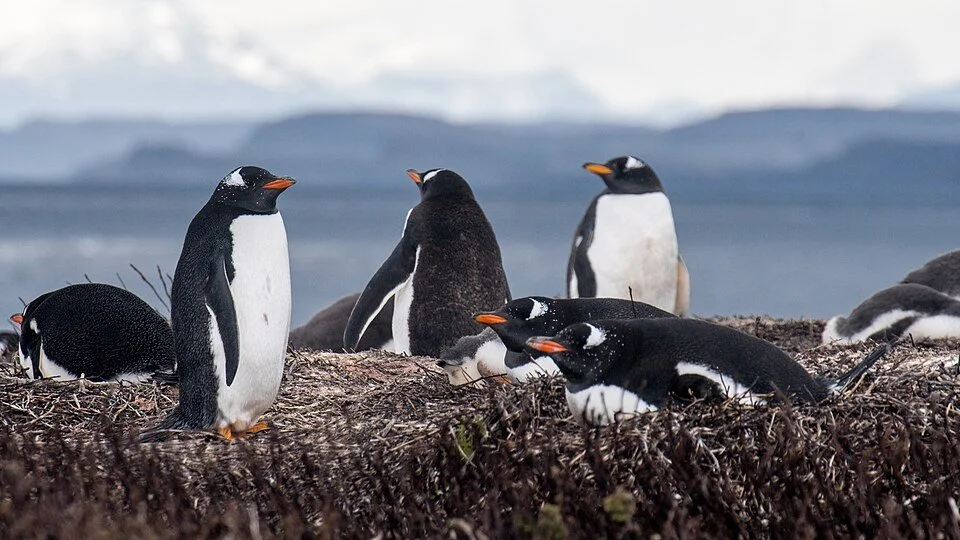
"2020-11 Kerguelen Islands - Gentoo penguin 23" by Antoine Lamielle is licensed under CC BY-SA 4.0.
In one of the most remote places on earth, a seemingly inconsequential bird has taken the world by storm. For the first time in over 100 years, a new penguin species has been discovered. Found in the Kerguelen islands (also known as the Desolation islands), the southeastern gentoo penguin, Pygoscelis kerguelensis, is the first unique penguin species to have been discovered since the Northern rockhopper penguin in 1921.
A Species Separated
Ranging from 10 to 18 pounds, gentoo penguins are stout black and white birds with a distinctive white splotch arching across their heads from eye to eye. They are a member of the brush-tailed penguin family, or Pygoscelis, and were long established to have four distinct subspecies, defined mainly by range:
The eastern gentoo penguin, found on the Crozet Islands, Prince Edward Islands, Kerguelen Islands, Heard Island, and Macquarie Island
The northern gentoo penguin, found on the Falkland Islands, Martillo Island in the Beagle Channel, and Isla de los Estados in Argentina
The southern gentoo penguin, found on the Antarctic Peninsula, the South Orkney Islands, South Shetland Islands and South Sandwich Islands
The South Georgia gentoo penguin, found on South Georgia island
However, recent discoveries have shown that these subspecies are more different than first expected. Scientists are now proposing that three of the subspecies should be classified as completely separate species – and a fourth, new species of gentoo has emerged.
How Isolation Turns Into Adaptation
In an article published in Communicates Biology in April of 2026, scientists from the United States and Chile described how the penguins differ not just by location but down to the genomes, with adaptations having evolved based on their habitats. While relatives like the emperor penguin journey hundreds of miles from their colonies to feed, gentoo penguins generally stay close to home. Their generalised diets of fish, krill, squid, and cuttlefish make it easy to find food. With no reason to travel, colonies become isolated, and their genetics begin to diverge.
The southern gentoo, which lives and breeds in frigid Antarctica, exhibits more genes tied to heat generation; whereas the eastern gentoo, found in the warmer Sub-Antarctic and Indian oceans, displays energy efficient adaptations geared toward deep diving. However, it is the southeastern gentoo penguin that has captured everyone’s attention. While the southern, eastern, and northern gentoo have been upgraded from subspecies to species (with the South Georgia penguin merging with the southern gentoo), the southeastern gentoo penguin is something completely new.
The Vulnerability of Location
At a glance, southeastern gentoo penguins are nearly indistinguishable from their brethren, but under the surface, scientists have found a bird that is uniquely suited to the islands that they call home. Yet it is these very adaptations that shine the light on the gentoo penguin’s weakness: location. As climate change places pressures on penguins, the gentoo’s narrow range could prove their downfall. If their homes become uninhabitable (which scientific predictions state could happen by the year 2050), these highly specialized penguins would find themselves unable to live anywhere else. The reclassification of gentoo penguin species is an important step in identifying their conservationary needs.